
Veranda Learning Solutions - Getting past the stressed balanced sheet
Multibaggers are only known in hindsight. Could Veranda be one?


The history of capital markets is replete with companies piling on huge debt on their balance sheets to grow its topline and more often than not leading to destruction of shareholder wealth over the long term -
Jaiprakash Associates, a highly diversified group in infra, cement and real estate borrowed heavily to fund massive projects . During the 2008 RE downturn it couldn’t service debt, projects stalled and revenues dried up. Share price peaked around 340 in May 2008 but declined relentelssly to below Rs. 40 by Oct 2008. Even today the stock price is Rs 3.99
Suzlon Energy a leading wind turbine maker took huge borrowings for overseas acquisitions in mid 2000s. Global slowdown in renewable equipment prices plus rising interest costs, strained finances. Stock collapsed from 460 in 2008 to below Rs 10 by 2013
There are other examples as well including Unitech, Bhushan Power & Steel, Alok Industries etc where heavy borrowing either to do massive expansions or to do aggresive M&As (Mergers and acquisitions) lead to huge financial stress and eventual collapse of the stock price and the business
The company that we are trying to study today fits in one of those categories. In fact its quite similar to Suzlon where the company has tried to grow its topline over the years through aggressive mergers and acquisitions. Founded in 2018, Veranda Learning is an education company offering diverse learning solutions. It provides online, offline and hybrid programs via coaching institutes, K12 schools and even colleges catering to students and professionals. Veranda operates across various segments including academics, vocational training, government test prep and commerce education. Over the years the company has mainly expanded through inorganic growth (acquisitions), as you can see in the image below. In FY 2024 itself it did a total of 9 acquisitions

All these acquisitions have led to robust topline growth but its come at a cost of loading up the balance sheet with heavy debt. The company IPOed in 2022 and since then the stock price in a range
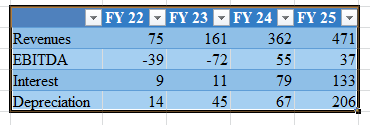
As you can see in the image above, the company made losses even on an operating level (EBITDA) in FY22 and FY23. Further in FY24 and FY25 their interest and depreciation each on their own were more than their operating profits. In fact the interest costs was 18% and 28% respectively of the FY24 and FY25 revenues. The peak debt of the company during this time (if you remove the lease liabilities) touched 514crs and the peak debt to equity was almost 2.0x, clearing not making for a good investment case
Acquisition Strategy
Despite this rough patch one of the reasons I kept tracking this company was due to the quality of the acquisitions Veranda was making. Their acquisition strategy has always been focused - acquire niche (focused on a particular domain of education), profitable and established brands that have a delivered a consistent record of outstanding results. Not only that while acquiring a brand they retained the faculty, allowing the incumbent founders of that particular brand to run the operations even after acquisitions. Normally in coaching business the reputation of the teacher/coach matters a lot in local macro markets. Often enrollments happen more based on the teacher than the brand. In retaining the faculty Veranda not just acquired the brand, the maintained the core strength of the brand as well. In addition Veranda optimised the operations of these brands by adding tech support, adding more courses to their offerings within the same domain, providing multi model learnings and expanding the geographic reach of those brands.

Take the example of Edureka. Before the acquisition by Veranda, Edureka was an online only education provider. Veranda took it offline as well, started coaching centers under “Edureka”.
RACE which was primarily an offline government test prep channel in Tamil Nadu, they took it online learning and expanded the portfolio to railway recruitment, tamil nadu state commission etc. exams
JK Shah Classes was a significant player providing only CA Coaching from the last 40 years. Post acquistion Veranda expanded the portfolio to include all commerce coarses under JK Shah - BCom, CMA, CMA, Cost Accountant, CFA, CPA, CS etc.
Likewise similar things they have done with all the brands that they have acquired -either add more courses, either make it multi model learning or simply start coaching centers in more locations. I won’t go into much detail about every single brand so as not to expand this post further but you get a gist of how the company has added an organic growth touch to their inorganic acquisitions. Not to mention Veranda right now has physical locations around 300 towns and cities under all the brands combined.
But as seen in the table above all these acquisitions made the balance sheet heavy, leading to cash burns and negative returns
What Changed? VERANDA 2.0
From 2018 to 2024 period all company did was to grow via acquistions and adding an organic touch to it through their ecosystem as we have seen above. But all this came at a cost of debt heavy balance sheet. In Feb 2024 concall though the company mentioned that around a year from then and once they get through the remaining of the planned acquisitions, they would change the fabric of the company. They effectively named this new planned fabric as VERANDA 2.0
Under VERANDA 2.0 the primary plan was to get done with acquisitions and start focusing on organic plus synergistic growth only. Deleveraging the balance sheet was one of the main priorities. To do this company even did a QIP worth Rs 357crs, out of which they used approx Rs. 250crs to pay down debt. This brought the promoter shareholding down from 53% to 33%. But what it did more importantly was bring down interest cost significantly. From interest costs being 28% of total revenues in FY25, in Q2 FY26 interest cost as part of total revenue was down to 15%. And it is expected to further go down in coming quarters and especially in FY27 as by the end of FY26 company is restructuring is debt. Out of the remaining 195crs of debt on the balance sheet, 70crs is promoter debt at around 9% but remaining 125crs are NCDs caryying an interest of 17% p.a. This debt will get refinanced by March and the interest costs are expected to come down significantly. Also company has annoucned that there would be no more equity dilution and even raising of debt from here on.
Some of the other strategies under VERANDA 2.0 were organic expansion via asset light model where in the company will offer franchises or lease the property to start new centers rather than buying them. Since most of the business comes from Southern India, company also plans to tap into more geographies.
Most importantly the biggest announcement that was made was a Demerger of their Commerce Education segment which is their cash cow, details of which we will look further in the post
The Four Business Segments of Veranda Learning
Academic Segment
Vocational Segment
Government Test Prep
Commerce Education
Further in the post we will talk about all these segments but for now lets consider Veranda into two parts - one is the commerce education vertical which is getting demerged into a separate entity and the other is all of the other three segments combined
DEMERGER of the Commer Education Segment
As said above one of the objectives of VERANDA 2.0 strategy was to do a demerger of the commerce vertical. But why the commerce division? Lets get down to it
Out of 471crs of revenues in FY25, the commerce division alone contributed to 281crs of it, which is approximately 60%. The total EBITDA contribution of this division was 100crs whereas the entity level EBITDA was only 37crs. So its clear from these numbers that the commerce division is being the flag bearer of the company is solely responsible for current operating level profits. Demerging this division would create significant value unlock
Important to note is that as part of the demerge process the commerce division would be entirely debt entity. That is the remaining 195crs of debt that is on company books, the demerged commerce vertical won’t carry any of it. The new entity would be named “JK Shah Commerce Education Limited”
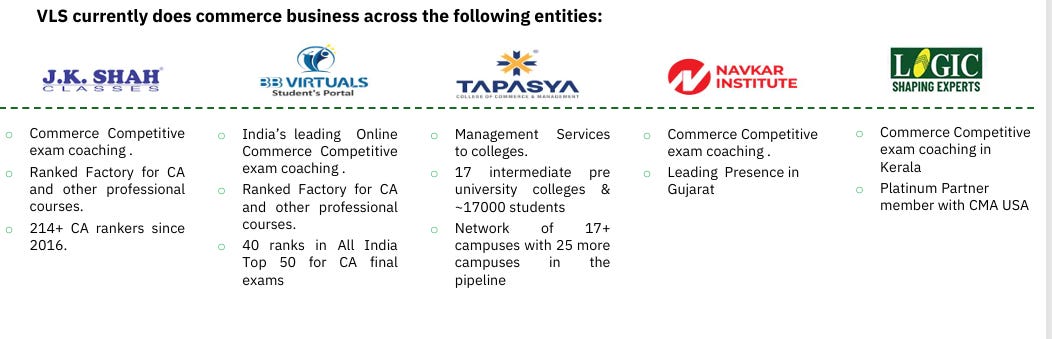
These are the 5 brands that Veranda does commerce business under. Out of this JK Shah Classes, led by professor JK Shah himself is the crown jewel of this company. As on date its a 42 year old brand with a huge reputation in Gujarat and Maharashtra. JK Shah allumni includes marquee names like Mr. Kumar Mangalam Birla (Birla Group), Mr. Piyush Goyal (Central Ministy) and Mr. Nilesh Shah (MD, Kotak AMC).
Talking about the other brands in the commerce division, BB Virtuals is a well known online commerce eduation platform. This digital going forward will also offer JK Shah courses enabling cross selling and synergies. Tapasya is managed colleges providing commerce courses in colleges. Going forward plan is to scale the number of manages under this brand. Navkar and Logic are offline commerce coaching centers in Gujarat and South India respectively.
FY26 guidance for the commerce division is 340crs of revenue with EBITDA of 160crs and PAT of around 100crs. By FY30 company has given a highly bullish target of 1000crs revenue just for the commerce segment which is almost 4 fold increase from FY25 revenues. The reason of such bullishness according to management is that since it would be a debt free entity, all the profits would go into expansion of their coaching centers under JK Shah, Logic and Navkar brands, increasing portfolio across all brands where in all the brands would be able to provide all commerce related courses under each of their centers rather than just provide CA Coaching or any other selective courses. BB Virtuals their only platform would also provide all these courses. Managed colleges under Tapasya which are 15 now, they plan to take it to 45-50 colleges by FY30.
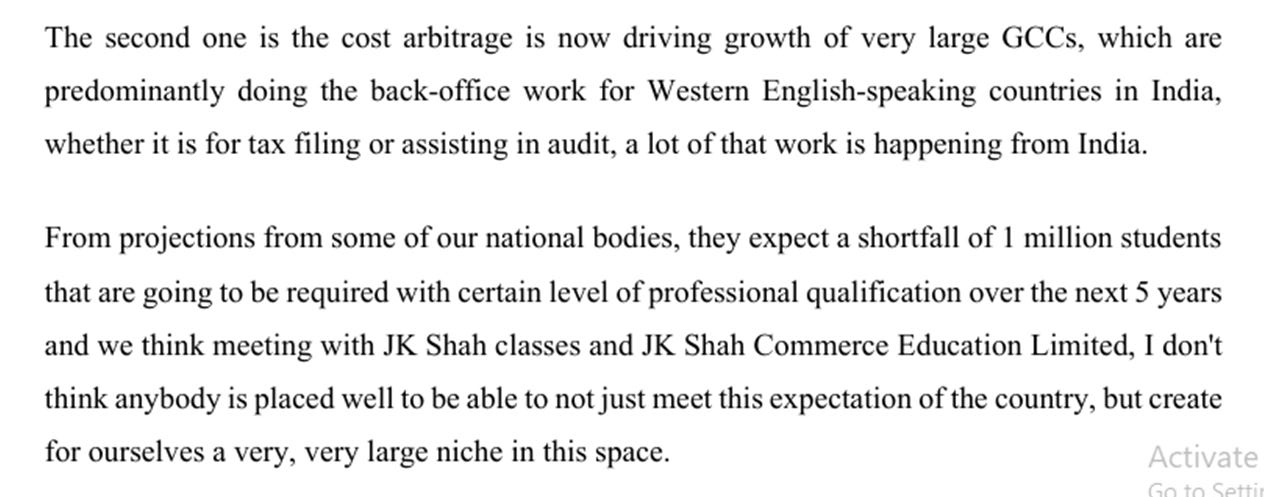
One external reason for bullishness for this segment which management has shared is the rise in GCCs in India, wherein they believe GCCs are not only bringing software work in India but also a lot of back office accounting work due to which requirements of accounting professionals should surge and JK Shah Commerce Education would be the leading institute to benefit from it. Below is the snippet from a concall:
Non Commerce Business (Acadmemic, Vocational and Government Test Prep)
The remaining entity (which we would now call non-commerce) that would be left post demerger is clearly the laggard business but Veranda has huge growth plans even for these 3 segments. They are targeting a 25-30% growth CAGR even for the non-commerce business. One of the key benefits for this non-commerce business would come from restructuring of the debt which we discussed above. As the days of acquisitions led growth are well past, the company plans to even pay down the remaining debt in next 3-4 years out of the cashflows generated. That itself would bring down costs quite a lot, helping the bottom line. Coming down to plans for each of the 3 business segments under the parent entity
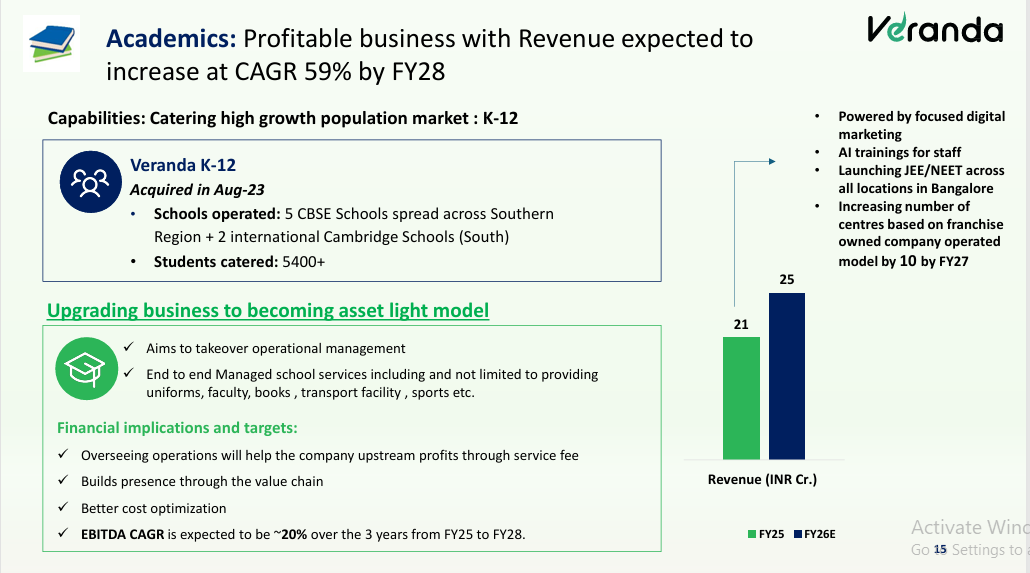
1) Academic Segment - This is the K12 segment where in Veranda manages schools and provide academic education education upto Class 12. Currently there are 5 CBSE schools and two international (ICSE) schools all in South India. Going forward company plans to grow this business in an asset light model where in they will take operational management of an existing school or lease the property from the owner. Target EBITDA growth of 20% from FY25 to FY28 in this segment. With only 7 schools in total in this segment FY25 revenues were only Rs. 21crs
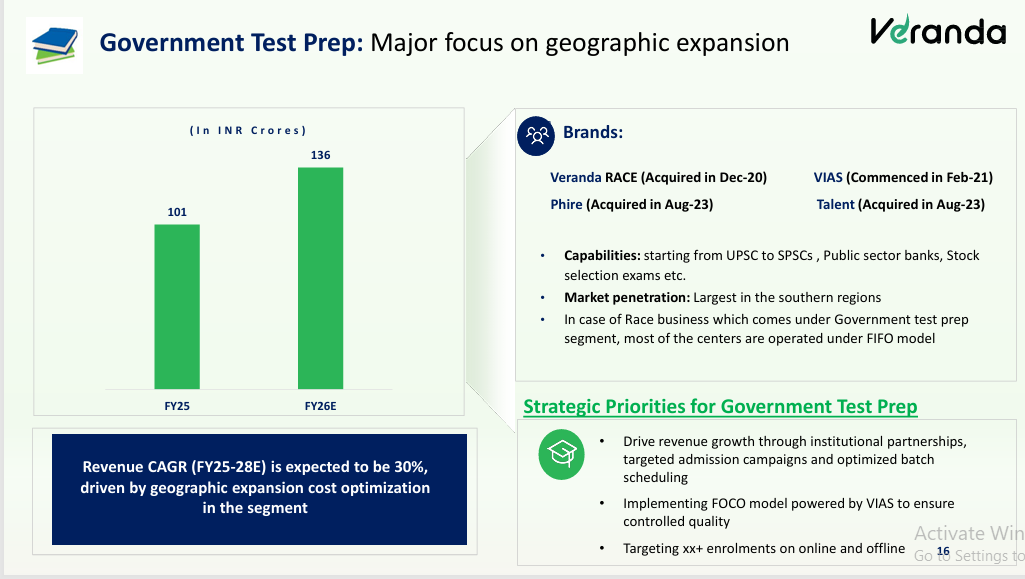
2) Government Test Prep - Brands like Veranda RACE, Phire, VIAS, Talent come under this segment. Veranda RACE in particular is the number one and largest brand in South India for government test prep. The major focus here is geographic expansion and the idea is to grow via franchise model - FOCO. Again this would allow asset light growth and minimal capex would be required to start new centers. Targeted revenue growth here is 30% CAGR over next few years. FY25 revenues from this segment were 101crs
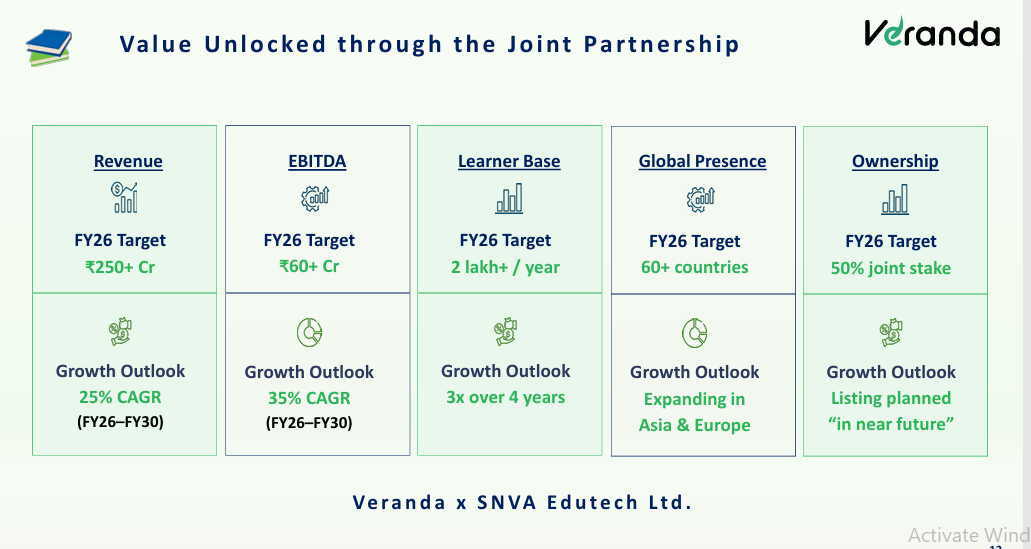
3) Vocational Segment - Vocational segment is basically upskilling and reskilling courses for professionals working in MNCs. This segment also includes higher foreign education. In this segment Veranda did revenues of 68crs in FY25. To scale this segment further Veranda has divested 50% stake in this segment and done a 50-50 JV with SNVA Edutech. SNVA Edutech is a top education company in professional skill based training with a global presence in 60 countries. The JV brings together Veranda’s domestic strength and SNVAs global network, accelarating growth for both the companies. Veranda expects this JV to grow revenues at 25% CAGR until FY30, with FY26 target of around 250crs.
So overall even in the non-commerce the management is expecting strong growth upwards of 25% across all 3 segments. Tracking the execution would be key here but management tone sounds confident and cross brand synergies should come into play
CONCLUSION
I am a big fan of demergers and companies going through a restructure either in thier business model or their debt. I constantly scan BSE Filings for such opportunities and that’s how Veranda came into my radar. Veranda meets some of these requirements. Theres a demerger of the commerce segment which would be debt free listing and theres a restructure of the debt of the non commerce segment post demerger and the business is also going through a transition wherein they are getting done with acquisitions and only focusing on organic growth which should lead to good cash flow generation and deleveraging of balance sheet plus possibly might throw out good dividends in the coming future
The demerger and execution in the non commerce segment is key here. Just doing a back of the envelope calculations and assuming the JK Shah Commerce vertical acheives a PAT of 100crs in FY27 (Management guidance is to do 100crs PAT in FY26 itself) then giving it a PE multiple of 20x gives us a Mcap of roughly 2000crs for the commerce segment alone post demerger. Company’s current Mcap including both the segments as of Friday close itself is 2082crs. So even if think of the non commerce segment as a laggard we are kind of getting it for free.
This is a classic Joel Greenblatt stock. Joel Greenblatt is widely known as the father of special situations investing (demergers). His hedge fund Gotham Capital gave annualised returns of 50% from 1985 to 1994 investing only in special situations.
“The secret to investing is to figure out the value of something – and then pay a lot less.”
- Joel Greenblatt
With Veranda I feel we are getting that where even if we discount the management guidance by quite a bit or delay it into the future then actually we are paying quite a less for the entity as a whole. The plan to demerge and list the demerged entity completely debt free, structure the remaining debt of the non commerce segment and stopping the acquisitions and having a focused approach on organic growth could lead to very high ROEs and ROCEs and a company with high ROEs and ROCEs and low to neglible debt with good growth prospects is usually valued high. Multibaggers are only known in hindsight could Veranda be one?
I am a Mutual Fund Distributor and an Independent Financial Advisor. I manage clients mutual funds and provide them with a good value add over long term. You can reach out to me on WhatsApp/Call at 9579163557 or write to me valuecapinvestments@gmail.com
Promoter is scammer